Read more from SPTC’s 2026 Issue 1 Newsletter
Jump to:
Strengthening Louisiana’s Coastal Resilience with Advanced Wave Pressure Modeling
New Mexico Researchers Develop Innovative Technology to Monitor Post-Wildfire Flooding
C3PEU: Concrete 3D Printing Experience for Undergraduates
OU ITE/TLC Student Chapter Hosts Talk: “From Classroom to Career”
Dr. Hasan Kazmee
SPTC Director, Musharraf Zaman, Becomes IACMAG President
New Mexico Researchers Develop Innovative Technology to Monitor Post-Wildfire Flooding
Excessive rainfall and flooding following wildfire flood events remain a major challenge for state DOTs. New Mexico has experienced wildfire damage for centuries, but the severity of these events has increased significantly in recent decades. In 2022, an unprecedented early series of wildfires burned large areas of land, heightening the risk of severe downstream flooding.
Addressing this critical issue, Dr. Fernando Moreu and his Smart Management of Infrastructure Laboratory (SMILab) at the University of New Mexico are conducting research to better understand the impact of natural disasters in rural and tribal communities and to identify solutions that enhance safety and resilience.
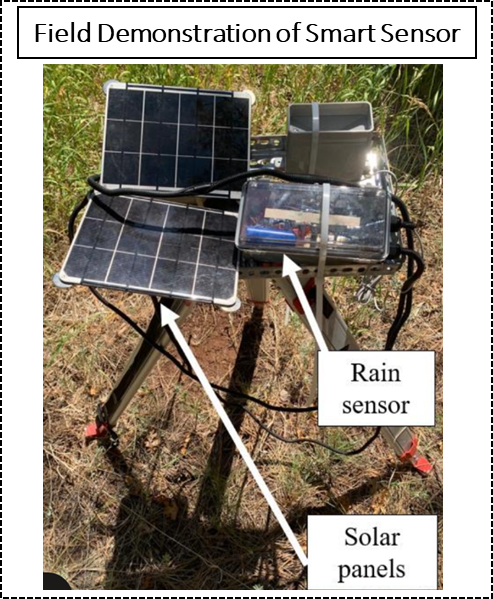
A recent project, funded by the Southern Plains Transportation Center (SPTC), has produced a cost-effective, scalable system that integrates Low-cost Efficient Wireless Intelligent Sensors (LEWIS) with augmented reality (AR) technology. The LEWIS sensors are designed to measure rainfall and flooding during significant post-wildfire flood events, providing early warnings to improve decision-making and safety. Engineered for durability, the sensors utilize solar panels and a low-power sleep mode, reducing energy consumption by 70% and allowing long-term autonomous operation even under challenging conditions. The AR simulations, developed and refined through workshops with tribal experts and emergency managers, leverage real-time field data to enhance disaster preparedness.
The project demonstrates that combining low-cost wireless sensors with AR technology can revolutionize disaster response, enabling immersive scenario-based training, more informed decision-making, and strengthened community resilience across diverse geographic areas. Developed in collaboration with industry partners, the technology also holds significant commercialization potential, which the research team plans to explore further.
C3PEU: Concrete 3D Printing Experience for Undergraduates
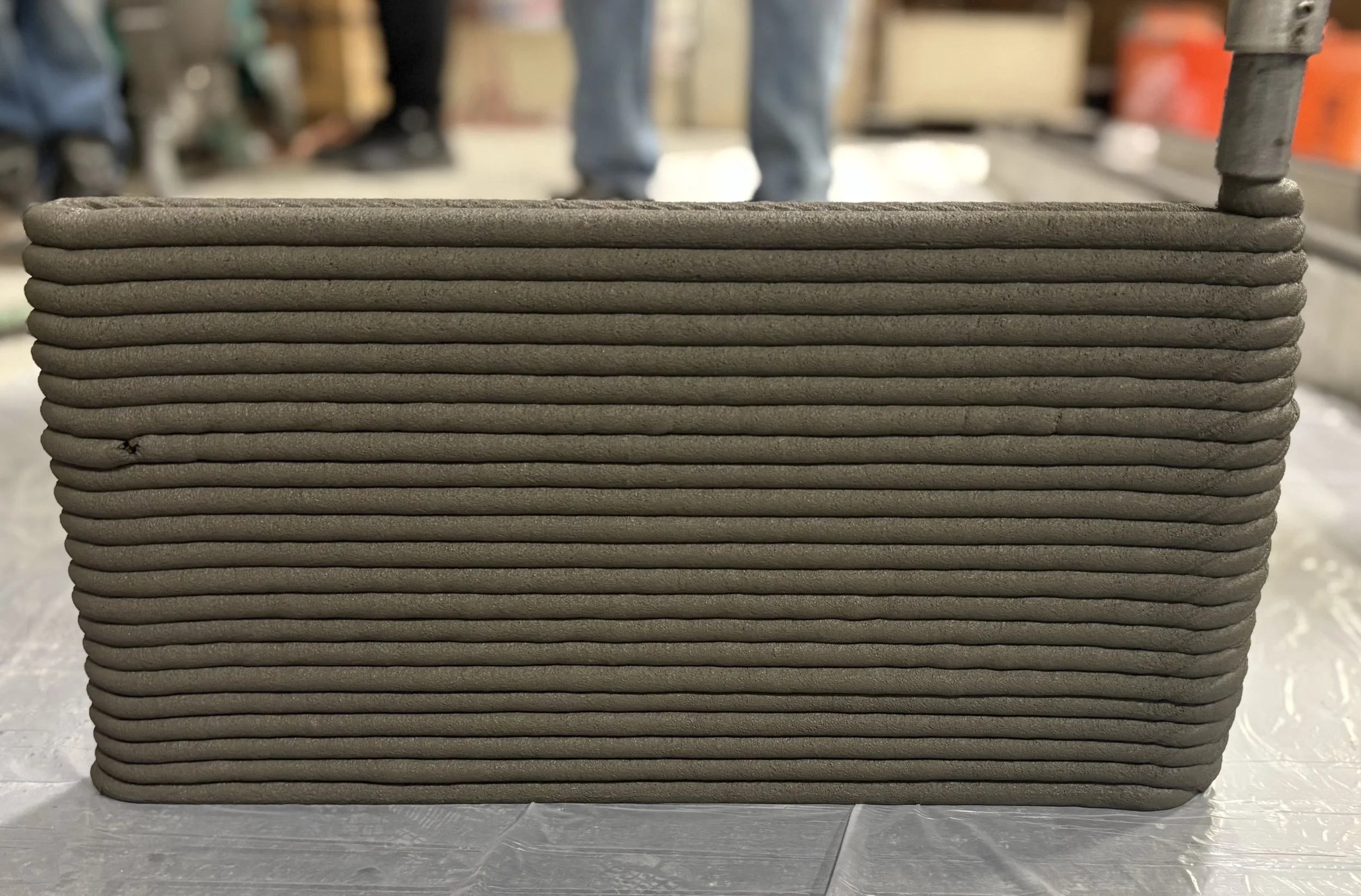
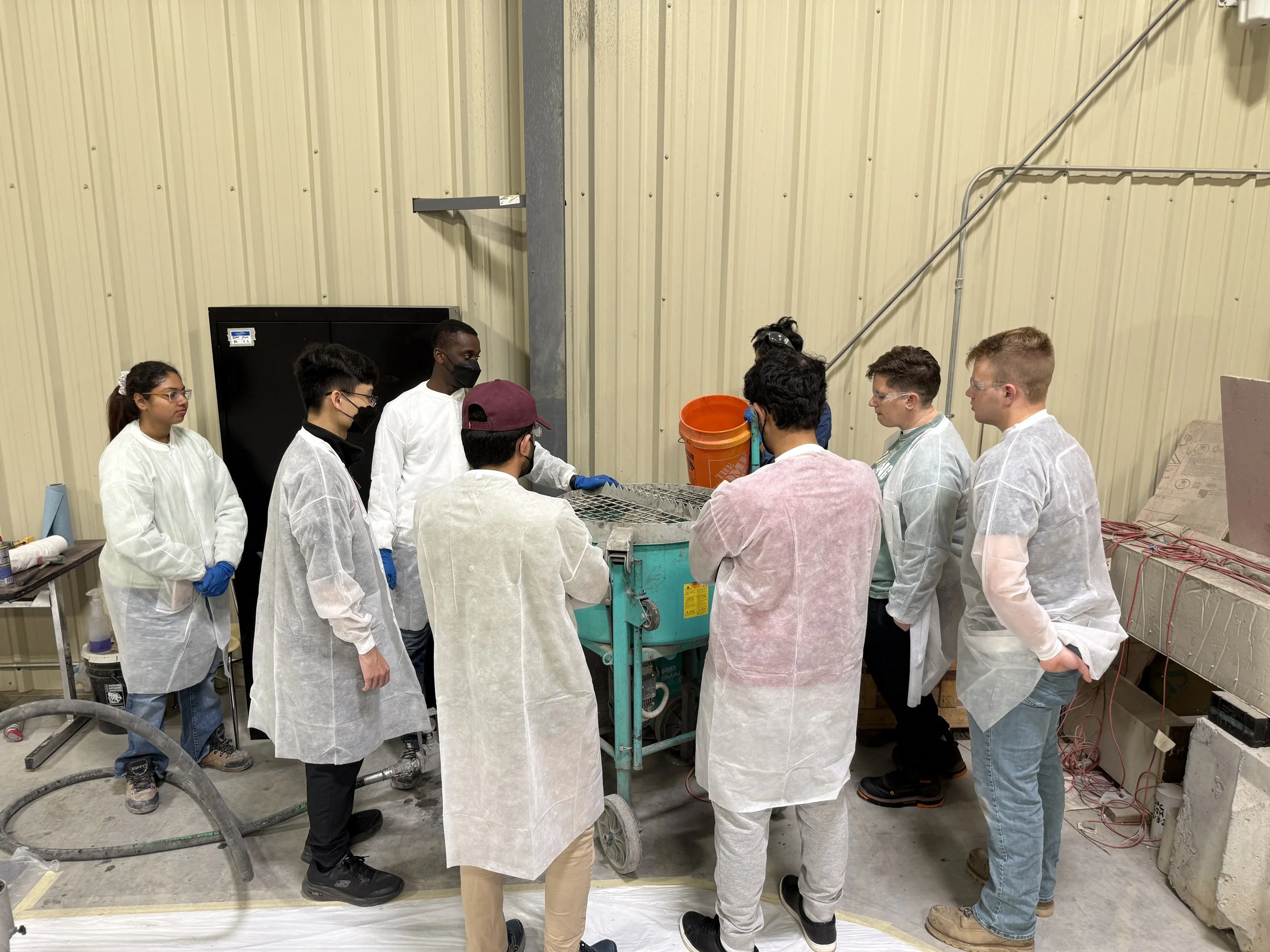
The Concrete 3D Printing Experience for Undergraduates (C3PEU) is a 10-week, SPTC-funded workshop made possible through the generous donation of Wes and Roni Perry. The program is possible by advanced 3D concrete printing equipment funded through the SEIP OU VPRP initiative, enabling students to train on state-of-the-art digital fabrication systems. This immersive program provides hands-on training in concrete 3D printing, guiding students through mix design, rheology control, extrusion optimization, geometric fabrication, and performance evaluation. Participants engage directly with advanced materials processing, digital fabrication systems, and real-time problem solving—bridging classroom knowledge with laboratory implementation.
C3PEU aligns strongly with SPTC’s mission to advance transportation materials innovation while strengthening workforce readiness. By integrating emerging construction technologies with foundational civil engineering principles, the program prepares students for evolving industry demands in automation, advanced manufacturing, and resilient infrastructure systems. Students gain technical competence, interdisciplinary collaboration skills, and exposure to research-driven practice.
Through experiential learning and industry-connected mentorship, C3PEU supports SPTC’s broader vision of cultivating a highly skilled, forward-thinking workforce equipped to lead the next generation of infrastructure innovation.
Workshop coordinators: Olivia Humphrey, Brandon Vu
PI: Shreya Vemuganti
Co-PI: Robert Nairn
Research Advisory Committee Spotlight
Dr. Hasan Kazmee
SPTC is pleased to announce the appointment of Dr. Hasan Kazmee to the SPTC Research Advisory Committee (RAC) for Cycle 4. Dr. Kazmee serves as a Senior Civil Engineer with Applied Research Associates, Inc., bringing more than a decade of specialized experience in airfield asphalt pavement materials, accelerated pavement testing, instrumentation, and large‑scale pavement performance modeling.
With a strong record of leading FAA‑sponsored research at the National Airport Pavement Test Facility (NAPTF) and National Airport Pavement and Materials Research Center (NAPMRC), Dr. Kazmee has contributed to national standards through high‑impact technical reports, peer‑reviewed publications, and data‑driven guidance for airfield pavement design and maintenance. His expertise includes managing complex datasets from advanced instrumentation, conducting laboratory and field characterization, and supporting specification development such as FAA’s P‑401 asphalt materials provisions.
Dr. Kazmee holds a Ph.D. in Civil Engineering from the University of Illinois at Urbana‑Champaign and has been recognized with multiple awards, including the Best Paper Award at the 2023 International Airfield & Highway Pavements Conference and the Outstanding Engineer Award from the Southern New Jersey Professional Society.
His technical depth, applied research experience, and commitment to advancing pavement engineering make him a valuable addition to SPTC’s RAC. The committee looks forward to his insights as Cycle 4 research priorities are shaped and advanced.
OU ITE/TLC Student Chapter Hosts Talk: “From Classroom to Career”
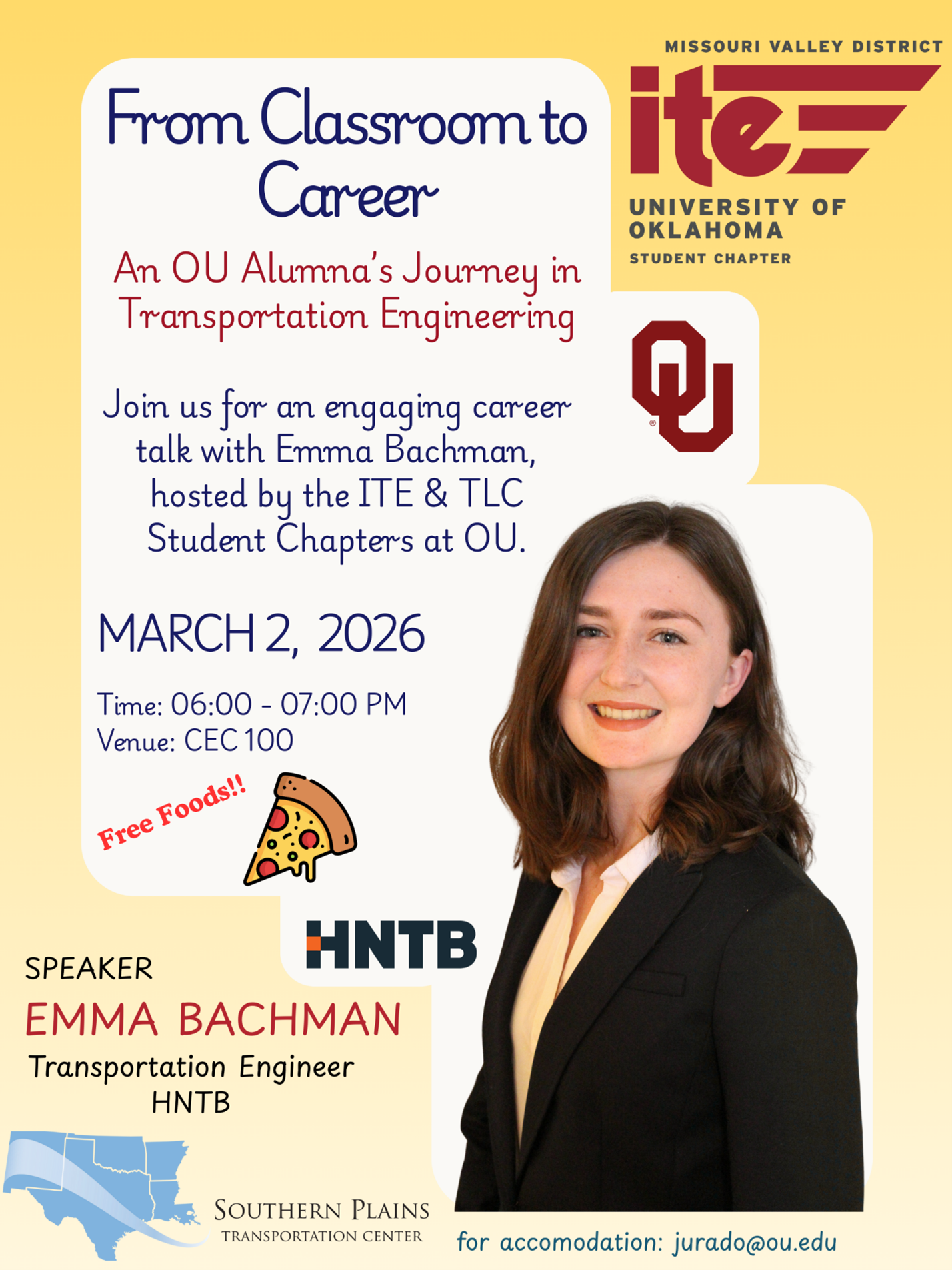
The OU ITE/TLC Student Chapter recently hosted a guest talk titled “From Classroom to Career” featuring Emma Bachman, PE, a transportation engineer with HNTB and an alumna of the University of Oklahoma. The event brought together students interested in transportation engineering for a discussion about professional practice, career paths, and the transition from academic training to industry work.
During the session, Ms. Bachman shared insights from her experience working on transportation projects and reflected on her own transition from university to professional practice. She described the types of responsibilities transportation engineers may encounter early in their careers, including roadway design tasks, coordination with multidisciplinary teams, and involvement in different stages of project development.
She also spoke about the importance of developing both technical and professional skills while in school. Topics such as communication, teamwork, and learning to adapt to new challenges were highlighted as important parts of early career development. Ms. Bachman encouraged students to seek opportunities to gain practical experience, connect with professionals in the field, and remain open to different areas within transportation engineering.
The discussion quickly became interactive. Students asked thoughtful questions about career paths, day-to-day engineering work, and the types of skills that are most valuable when starting in the transportation field. The session offered useful perspectives for students who are exploring career options and preparing to enter the engineering workforce.
Strengthening Louisiana’s Coastal Resilience with Advanced Wave Pressure Modeling
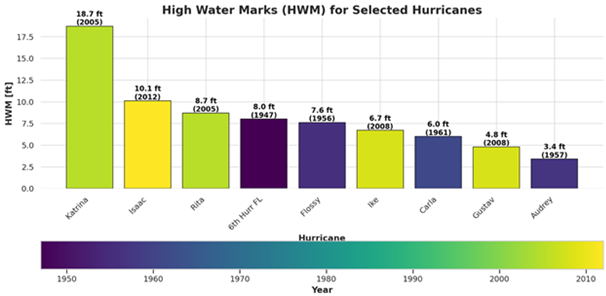
Coastal embankments are vital for safeguarding Louisiana's hurricane-prone regions, serving as barriers against flooding and storm surges while supporting critical infrastructure such as evacuation routes and disaster response pathways. The state’s coastline is increasingly at risk due to persistent challenges, including extensive land loss, rising sea levels, and the intensifying impacts of hurricanes. Major storms like Katrina (2005), Laura (2020), and Ida (2021) have highlighted the destructive potential of extreme weather events, emphasizing the need for embankments designed to withstand both routine wave forces and the extreme conditions generated during hurricanes.
A team at Louisiana Tech University, led by Dr. Jay X. Wang, has evaluated the wave hydrodynamic forces on coastal embankments along Louisiana’s coastline, addressing gaps in traditional methodologies for wave height prediction and force estimation. Conventional approaches do not capture the spatial variability in wave height across a region. To overcome this limitation, in this study, wave pressure envelopes were developed considering a comprehensive spatial representation of wave heights for different return periods. The developed wave pressure envelope improved the design of coastal embankments and the assessment of vulnerability of existing embankments to hurricanes. The findings of this project are being implemented by the Coastal Protection and Restoration Authority of Louisiana (CPRA) to enhance the agency’s dike design practices for coastal marsh creation projects. In their feedback, CPRA highlighted that the proposed method for calculating wave pressure could significantly influence future dike (embankment) designs for wetland protection projects. This study was supported by the Southern Plains Transportation Center (SPTC), a regional University Transportation Center (UTC) for USDOT Region 6.
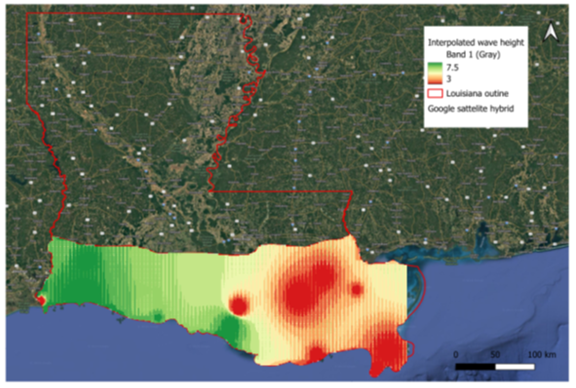
Spatial Distribution of 20-Year Return Period Wave Heights Along the Louisiana Coastline
Highest wave height recorded at each station
SPTC Director, Musharraf Zaman, Becomes IACMAG President
At the 17th IACMAG International Conference, held in Hong Kong last December, the IACMAG Board of Directors voted unanimously in favor of Musharraf Zaman to lead this scholarship-driven international organization as its president. Established in 1988, the International Association for Computer Methods and Advances in Geomechanics (IACMAG) organizes successful international conferences every three to four years. With 233 participants from 21 countries and a top-quality program by any standard, the 17th IACMAG International Conference was a highly successful event. As in previous conferences, IACMAG recognized geomechanics researchers worldwide for their original contributions and leadership in geomechanics. IAMAG is also a co-sponsor of the International Journal of Geomechanics (IJOG), ASCE Geo-Institute. Musharraf served as the Editor-in-Chief of this prestigious journal for eleven years (2009-2020). As president, he plans to strengthen collaborations between IACMAG and ASCE Geo-Institute through hosting joint technical sessions at conferences and symposia, co-sponsoring student competitions, and pursuing other collaborative activities of common interest. Under his leadership, IACMAG has already started several new activities, including the Chandrakant Desai Memorial Webinar Series, a quarterly event to retain the legacy of Prof. Desai, the founding president of IACMAG and founding Editor-in-Chief of IJOG (visit https://www.iacmag.net/webinars-1 for video recordings of recent webinars). Among other initiatives in his new role, he is working on the 2027 IACMAG symposium, to be held at the University of Newcastle, Australia, 18th IACMAG International Conference, to be held in India in 2028, and IACMAG newsletter, along with the Board and Directors and others (see https://www.iacmag.net/ for details).